

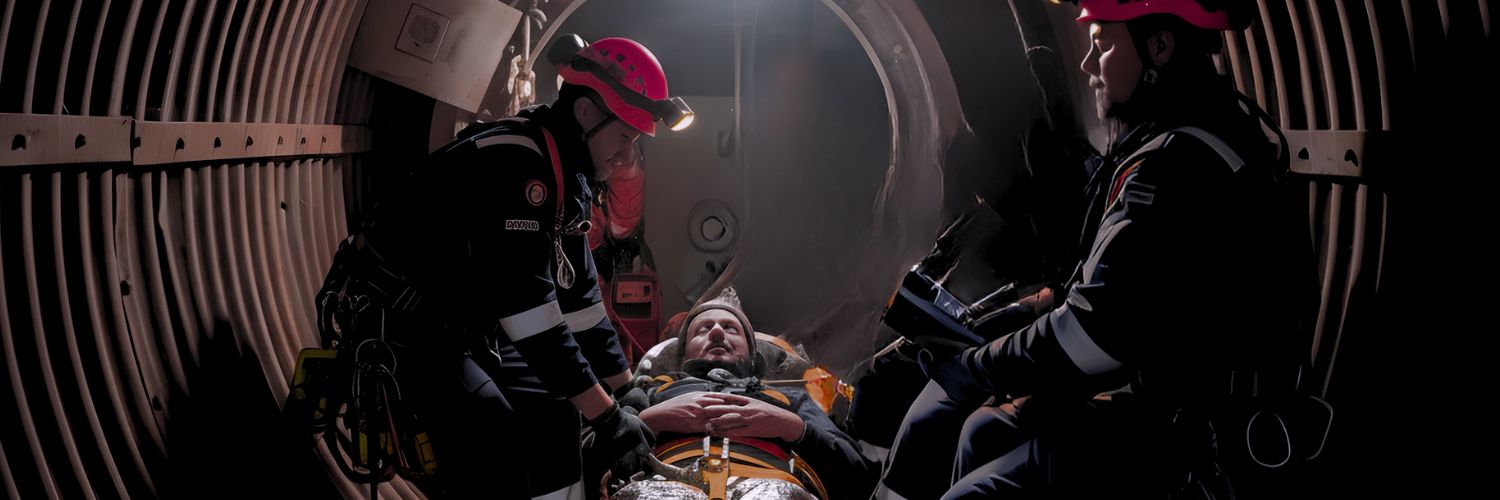
In confined space rescue, the distinction between urgent vs emergent moves hinges on the immediate threat level. Emergent moves occur when the environment itself, such as an IDLH atmosphere or engulfment hazard, threatens the life of both the victim and the rescuer, requiring immediate extraction without spinal precautions. Urgent moves apply when the environment is stable, but the victim’s internal clinical condition requires rapid transport for life-saving medical intervention.
Urgent vs Emergent in Confined Spaces
Time operates differently inside a permit-required confined space. Seconds don’t just measure progress; they measure brain viability. For industrial rescue teams, the decision to move a fallen worker involves a brutal calculation: speed versus stability.
While the terms are often used interchangeably in casual conversation, the technical distinction dictates your rigging, your PPE, and your liability.
- Emergent Moves: The danger is external. The space is trying to kill you.
- Urgent Moves: The danger is internal. The victim’s body is failing.
Emergent Moves: When the Environment is the Enemy
An emergent move is a “drag-and-go” scenario. You perform these when staying in the space for even sixty additional seconds guarantees a double fatality. In these cases, rescuers abandon traditional cervical spine (C-spine) stabilization because a paralyzed survivor is preferable to a dead one.
Identifying IDLH Triggers
Rescuers must trigger an emergent move when the atmosphere reaches IDLH (Immediately Dangerous to Life or Health) levels. This includes:
- Oxygen Deficiency: Levels dropping below 19.5% causing immediate cognitive impairment.
- Explosive Limits: Methane or dust concentrations approaching the Lower Explosive Limit (LEL).
- Engulfment: Rising fluids or shifting solids like grain or sand.
The “Drag and Go” Protocol
As an emergency measure, you use the victim’s clothing, a specialized drag strap, or a wristlet. You pull along the long axis of the body, and do not wait for a litter. You do not check for fractures. You exit.
Urgent Moves: When the Patient Cannot Wait
An urgent move occurs in a “stable” environment. The air is monitored and safe, the lockout/tagout (LOTO) is secure, but the victim is experiencing a critical medical event.
Clinical Instability
You transition to an urgent move if the victim shows signs of:
- Heat Stroke: Core temperature spikes that require immediate cooling.
- Myocardial Infarction: A heart attack requiring ACLS intervention.
- Hypovolemic Shock: Rapid internal bleeding from a fall.
Rapid Extrication Techniques
Unlike emergent moves, urgent moves allow for “modified” packaging. You might use a Sked stretcher or a Kendrick Extrication Device (KED). These tools provide enough rigidity to protect the spine while remaining slim enough to fit through a 24-inch manway.
The Rescue Prism: Real-Time Decision Making
Industrial rescuers evaluate three specific metrics to decide between an emergency move and a standard extraction:
Atmospheric Conditions: An Emergent Move is mandatory if the environment is unstable or IDLH. Conversely, an Urgent Move occurs when the atmosphere is monitored and confirmed to be safe.
Spinal Precaution Protocols: During Emergent Moves, rescuers ignore spinal precautions to prioritize sheer speed. In Urgent Moves, spinal precautions are minimized to expedite extraction while still being maintained where possible.
Equipment Selection: Emergent Moves utilize basic drag straps or wristlets for immediate hauling. Urgent Moves employs specialized rapid-deployment gear, such as the Sked, KED, and technical rescue harnesses.
Primary Extraction Goal: The goal of an Emergent Move is the raw survival of both the rescuer and the victim. The goal of an Urgent Move is to provide medical stabilization while ensuring rapid transport to advanced care.
Tactical Execution of Emergency Moves
Effective industrial rescue relies on mechanical advantage and pre-rigged systems.
Non-Entry Retrieval
OSHA 1910.146 prioritizes non-entry. If a worker wears a full-body harness attached to a mechanical winch, an emergent move becomes a matter of cranking the handle. This is the safest “emergency move” because it risks zero additional personnel.
The Five-Minute Rule
Biological death begins within 4 to 6 minutes of oxygen deprivation. If your rescue plan takes seven minutes to “package” a victim in an oxygen-deficient tank, you are performing a recovery, not a rescue. Emergent moves bypass the “perfect” tie-in to meet this physiological deadline.
Equipment Essentials for High-Speed Extractions
Standard baskets and backboards fail in tight industrial geometries. Your cache must include:
- Vertical Lift Slings: For narrow portal egress.
- Low-Profile Retrieval Lines: Synthetic ropes that don’t snag on internal baffling.
- Pneumatic High-Angle Kits: For quick-deploy mechanical advantage (3:1 or 4:1) to overcome the friction of a victim’s body against a steel floor.
Frequently Asked Questions (FAQ)
Can an attendant perform an emergent move?
Only if they can do so from outside the space using a retrieval line. Attendants must never enter the space for a move unless relieved by a trained entry team.
Does OSHA allow rescuers to ignore the C-spine?
Yes, under the “Life over Limb” principle. If the environment is untenable, the priority is extraction to a fresh-air environment.
What is the most common mistake in urgent moves?
Over-packaging. Rescuers often spend too much time securing every strap on a litter when the patient actually needs a rapid ride to a trauma center.
Bridging the Gap with DCS Rescue
When seconds determine the outcome of a confined space incident, having a pre-verified strategy is your only true safeguard. DCS Rescue specializes in bridging the gap between high-level OSHA compliance and the gritty reality of industrial rescue. As a leader in technical rescue services, DCS provides fully equipped, elite teams capable of executing both urgent medical extractions and high-stakes emergent moves in IDLH environments. Beyond on-site rescue standby, they offer comprehensive hazard assessments, permit writing, and professional safety oversight, ensuring your facility meets the requirements of T8 CCR 5157 and 29 CFR 1910.146 without the overhead of an in-house team. Whether you are navigating a complex plant turnaround or a high-risk new construction project, DCS Rescue delivers the technical expertise and rapid-response capabilities required to protect your most valuable asset: your people.